
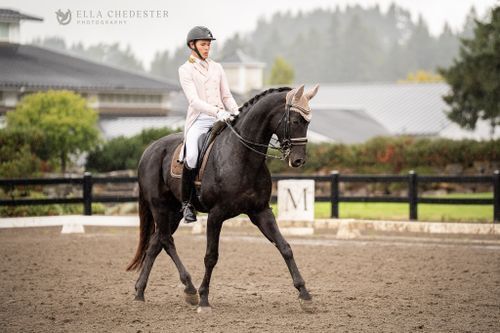
Photo by Ella Chedester Photography
Day One Journal:
While at Havensafe Farm, owner Betsy Juliano shared valuable insights on sponsorships, emphasizing that she enjoys watching horses develop and that a rider’s reputation begins early, making it important to be mindful of what is shared publicly. She stressed that successful sponsorships are built on shared values and philosophy between the rider and the brand.
Scott Hassler’s educational focus centered on piaffe work and the importance of establishing rhythm before attempting to add expression or difficulty. He explained that correct piaffe can only develop once rhythm is secure, and that this rhythm can be improved through exercises such as working in three tracks and jogging in place. Scott emphasized fairness to the horse and the importance of listening to what the horse is offering, reinforcing the idea that horses are constantly communicating with the rider if attention is paid.
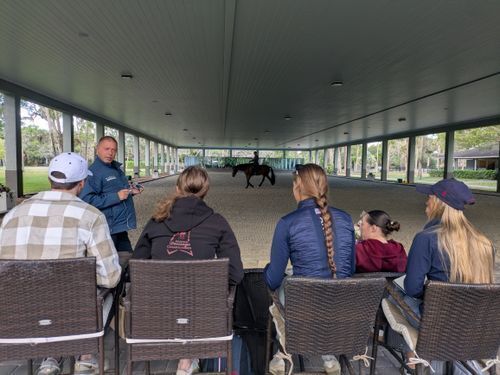
Learning from Scott Hassler
At the Dressage Infusion Masterclass at the Adequan Global Dressage Festival, the emphasis was placed on clarity and effectiveness of the rider’s aids. Increased contact in the canter was addressed through correct use of the outside leg, with the whip kept on the outside to encourage engagement of the outside hind leg. In the turn on the forehand, the horse was expected to step clearly across, reinforcing lateral responsiveness. Half halts were emphasized as being executed with one hand rather than pulling with both. An exercise used to test attentiveness involved riding a rising trot for two beats and then sitting for one, assessing whether the horse remained responsive. Riders were encouraged to sit deeply on their seat bones, remain relaxed in the saddle, and influence the front legs to help the horse maintain balance. As Kyra Kyrklund noted, “Flying changes are very personable between the rider and horse.” She suggested that to introduce changes, a recommended exercise was riding a half 10-meter circle, straight line, change, followed by another half 10-meter circle.
Day Two:
Today was a really lovely and interesting day. We spent most of it talking with several different people and hearing all these different perspectives on dressage, including what it’s like to be involved with dressage in Wellington. These discussions made the whole experience feel very real - and in a way "attainable." The conversations covered a lot of ground, from how people got started to where they are now, and what it actually takes to work and survive in a place like Wellington. One thing they all said in common is that you can't get here and sleep all day; you have to work quite hard for it.
One of the most eye-opening parts was learning about the different pathways people take to end up working in Wellington. There isn’t one straight line, but hearing how varied everyone’s journeys were made it clear that flexibility and persistence matter just as much as talent. We also talked about how and why trainers choose to move to Wellington, and what draws them there year after year. It truly highlights how much planning, sacrifice, and timing go into those decisions.
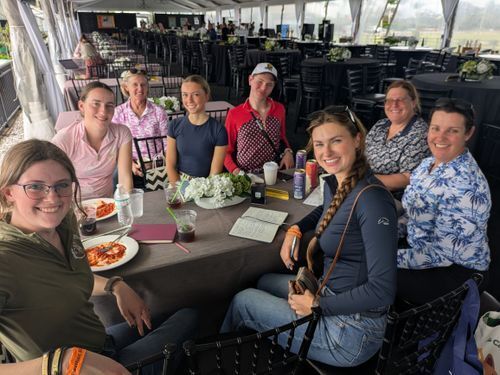
Learning how to get involved in dressage with Heather Petersen
A huge highlight was being able to watch several rides in the CDI 5* FEI Grand Prix. Seeing that level of sport up close was incredible. Watching the precision, the softness, and the partnership between horse and rider was extremely motivating. There’s so much you can learn just by observing—it was fascinating to watch.
We also had the chance to meet and talk with Jennifer Williams, Molly Maloney, and Ali Brock, which was really special. I found it especially interesting hearing Molly talk about rehabbing a Grand Prix horse after surgery, or if the horse goes lame. It was a good reminder that every horse is different and that rehab looks different for every situation, and to be frank, that one hit pretty darn close to home! I’ve had my fair share of rehab experiences, too.
Overall, it was a valuable and inspiring day, and I’m really looking forward to Friday Night Lights.
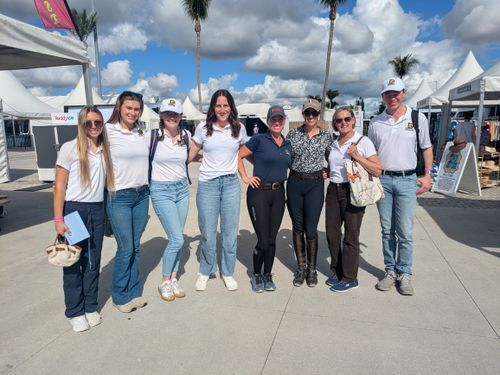
With Lauren Chumley and Ali Potasky
Day Three:
Day three really felt like a reminder of how much perspective matters in this sport.
Listening to Robert Dover talk about wanting to start a national mentoring program for U25 riders stood out to me. It wasn’t just about high performance, but about guidance, access, and giving younger riders a clearer path forward. He spoke about how important Pony Club was “back then,” and it made me think about how foundational programs shape riders long before the spotlight ever hits. You don’t just wake up one day riding the Grand Prix—you’re built over years by the people and systems around you.
What hit hardest was hearing him reflect on being an Olympic athlete and a four-time medalist, yet choosing to focus on his mistakes rather than just his wins. When he talked about his first Olympics and writing a book centered on his mistakes, it reflected (in a way) success for me. The idea that “success produces confidence, and confidence produces more success” feels simple, but it’s real. Confidence isn’t something you fake; it’s something you earn through experience, including failure.
The discussion about scoring trends over time was interesting. Horses scoring in the low 70s at Grand Prix in the early 1990s would be sitting around a 61 today. It really drives home how much the sport has evolved, not just in judging, but in breeding and horse quality overall. The horses themselves have changed, and expectations have risen with them.
We also met with Lauren Chumley and Ali Potasky. Lauren’s comments balanced that perfectly. She emphasized that every horse develops at its own pace, and that not every path has to be rushed. Hearing that her first Grand Prix horse didn’t learn the Grand Prix until 19 reinforced the idea that longevity matters more than speed. Especially when it comes to FEI young horse divisions, it was refreshing to hear that 5-, 6-, and 7-year-old tests aren’t for every horse—and that they shouldn’t be. This day felt like permission to slow down, trust the process, and ride the horse in front of you.
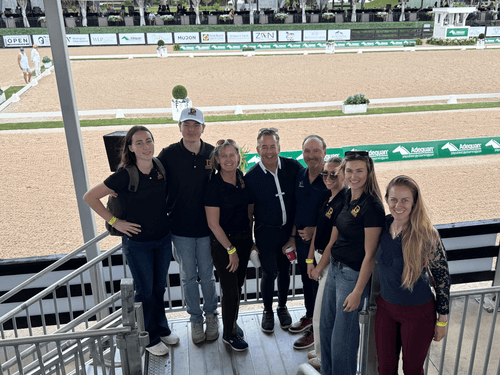
With Bill McMullin and Bill Warren!
Day Four:
Today was more centered on balance—both physically in the saddle and mentally in how we approach training and education. Our discussion with Dr. Hilary Clayton around bodywork stood out right away. Things like the Masterson Method and general bodywork may not always meet sport innovation standards for “proven” status, but that doesn’t mean they don’t work. It just means there isn’t enough research yet. The reminder to stay open-minded, and to learn something from everyone—even if that lesson is what not to do is important.
Hearing Bill Warren and Bill McMullin speak brought everything back to structure and education. Bill Warren’s experience judging at both national and FEI Grand Prix levels made his comment that “the transitions tell me [you] the truth” made a lot of sense. It reinforced how much the quality of the basics matter, no matter how advanced the work looks. Hearing the encouragement to start the USDF “L” Education Program purely for education—or, if possible, to audit—made it feel more like everyone should do it, so that the U.S. has more structure.
Bill’s breakdown of the Dressage Development Program clarified how much structure has been missing in U.S. rider education. From Training through FEI levels, with seminars on judging, teaching, and riding, plus assessments, it feels like there is a complete pathway. The idea of progressing through the “L” Program and then certification makes the whole system feel more intentional.
Adrienne Lyle’s session tied everything together on the riding side. Her emphasis on leg yielding to test the horse, staying centered over the saddle without pushing into the stirrups, and collecting on a 20-meter circle reinforced balance before power. I especially liked the reminder to warm up and teach new concepts on the easier side, then gradually push outside the comfort zone—mentally and physically. The final takeaway felt simple but powerful: only when you have balance can you truly add power.
Wrap-Up:
This week in Wellington for The Dressage Foundation’s Dream Program was one of those experiences that really sticks with you. It wasn’t just about riding better—it was about understanding the bigger picture of what it means to grow in this sport.
Two things stood out to me more than anything else. The first was Scott Hassler’s teaching. His focus on rhythm before expression completely reframed how I think about advanced work, especially piaffe. The reminder that correct work can’t exist without a clear, consistent rhythm was simple but powerful. His emphasis on fairness to the horse, listening to what the horse is offering, and not forcing something that isn’t ready yet really resonated with me. It reinforced that progress comes from patience and clarity, not pushing harder. So much of his teaching came back to doing the basics honestly and allowing the horse to develop through correct, thoughtful work.
The second takeaway was something Betsy Juliano said about reputation. Hearing that a rider’s reputation starts far earlier than most people realize was eye-opening. It made me think more carefully about how I present myself, both in person and online. Sponsorships and opportunities aren’t just about results—they’re built on shared values, consistency, and how you carry yourself over time. That perspective made it clear that every interaction matters, and that building trust and respect in this sport happens long before big scores or titles.
This experience made Wellington feel more attainable. Listening to professionals talk about their paths showed that there isn’t one right way to get here, but there is a common thread of hard work, commitment, and intention. Watching top-level sport up close and hearing honest conversations about setbacks and development made it feel more realistic.
I’m incredibly grateful to the donors who made this opportunity possible. Because of your support, I was able to learn from people I truly look up to and gain lessons that will stay with me long after this week. Thank you for believing in riders like me and investing in the future of our sport.


