
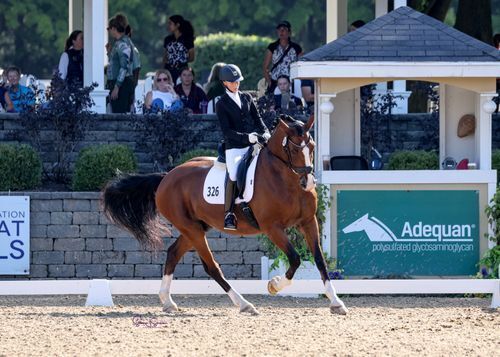
Day One Journal:
On day one of TDF’s Dream Program: Wellington, we had an early start, arriving at Havensafe Farm at 7:40 a.m. We began the morning observing a lesson taught by Scott Hassler to rider Jen Baumert. Scott shared invaluable insights, strongly emphasizing training from the horse’s point of view. He explained that when challenges arise, we must “coach the horse through it” rather than “work the horse through it,” highlighting the importance of clear communication, thoughtful aids, and an understanding of how the horse experiences our requests.
Following Scott’s session, we observed a lesson taught by Beth Baumert to Jen Baumert. Beth offered fresh perspectives and practical exercises, including the idea that in piaffe, the rider is simply riding the horse’s back through larger and smaller steps, rather than overcomplicating the movement itself. While at Havensafe, we also had the opportunity to meet Betsy Juliano, owner of the farm and of Olympic horse Salvino. She provided valuable advice on securing and maintaining sponsorships, stressing the importance of communication, professionalism, and aligning interests between sponsor and rider to build a strong and reputable partnership.
We then spoke with Canadian Olympian Jacquie Brooks, who shared parts of her daily routine and discussed challenges faced even at the highest levels of the sport. She encouraged us to prioritize education over purchasing a high-end horse and reassured us that not every horse will reach the top—and that this is okay.
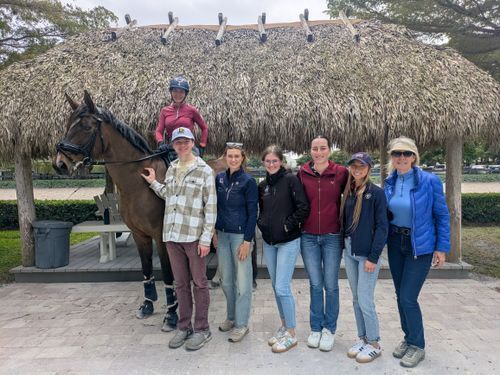
With Charlotte Bredahl
To conclude our morning, we watched Charlotte Bredahl coach at IDA Farm, gaining new exercises and insights into our own riding. In the afternoon, we traveled to the Adequan Global Dressage Festival, where we watched the CDI jog and observed Charlotte Bredahl teaching her FEI Junior rider, Alexis Troutman. We also had the opportunity to speak with U.S. Dressage Chef d’Équipe Christine Traurig and Para Dressage Chef Michel Assouline, who shared insights into their roles and career paths.
To finish the day, we attended the Dressage Infusion Masterclass featuring Olympic dressage riders Cathrine Dufour, Kyra Kyrklund, and Jan Brink. We watched a variety of rides from five-year-olds to Grand Prix, all showcasing exceptional horses and riders and leaving us with invaluable techniques that reinforced the importance of correct, compassionate training.
Day Two:
Day two of the Wellington Dream Program began at Roseview South with David Marcus and Molly Maloney. We started by watching Molly pilot a talented five-year-old, coming six-year-old gelding under David’s guidance. This session offered valuable tools for improving both horse and rider balance, along with thoughtful exercises designed to help loosen and stretch the horse. What stood out most to me was the emphasis both David and Molly placed on relaxation. Their focus on ease and softness was refreshing to me.
Following that ride, we watched Molly teach Judy Sloan aboard her Grand Prix Lusitano gelding. This lesson was incredibly engaging and reinforced the importance of never outgrowing the fundamentals. One comment from Molly that resonated deeply was, “It’s important not to lose the Training Level horse in your Grand Prix horse.” That reminder highlighted how correct basics remain essential, even at the highest levels of the sport.
To conclude our time at Roseview, we watched Molly ride her Grand Prix horse, TT, and listened as she shared their inspiring story of his recent rehabilitation and recovery. At the end of the ride, Molly spoke about perseverance, emphasizing the importance of commitment and consistency. Her words, “It’s not easy, it’s not done lying down, but it’s possible,” were both motivating and empowering.
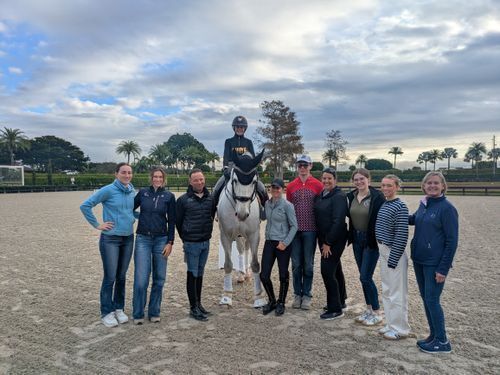
A morning at Roseview South with Judy Sloan, David Marcus, and Molly Maloney!
In the afternoon and evening, we watched the CDI 3* Grand Prix and the CDI 5* Grand Prix at the Adequan Global Dressage Festival, both of which showcased exceptional horses and riders performing at the highest level of the sport. Between rides, we had the opportunity to connect with influential figures in the dressage community, including Ali Brock, Jennifer Williams, Sarah and Lee Tubman, and Heather Petersen. They shared insights on the importance of work ethic and reputation as emerging professionals, as well as their hopes for the future of dressage—one we, as Dream Program participants, aspire to help shape.
Day Three:
Day three of the Dream Program was an incredible blend of spectating and meaningful conversations with industry leaders.
We began our morning at the Adequan Global Dressage Festival, watching several CDI classes, including the U25 Grand Prix and the FEI Intermediate I. During these classes, we had the opportunity to speak with Ellie Brimmer, a Grade II Para-Dressage rider. Ellie shared her involvement in USEF governance and discussed several committees she serves on, noting that the awards committee is her favorite due to its positive and encouraging atmosphere.
Following the classes, we met with Lauren Chumley and Ali Potasky, both recipients of TDF grants. They spoke about their humble beginnings and shared their training philosophies. With extensive experience developing horses from the grassroots level to Grand Prix, they offered valuable insight that directly related to my own questions about bringing along my two young horses. Both emphasized the importance of a positive attitude, along with the impact of a consistent program and routine, all with a touch of humor.
In the afternoon, we traveled to High Meadow Farm to observe renowned coach Richard White. The first session included many transitions, both within the gait and out of the gait to enhance throughness and collection. The rider’s consistent reassurance of her horse stood out to me, and Richard’s statement, “You’re creating a back to sit on with every stride,” deeply resonated.
We then watched Olivia LaGoy-Weltz ride a six-year-old gelding. Her ride highlighted the fundamentals of dressage, particularly the importance of clearly separating leg and hand aids. She concluded by reminding us that “self-carriage must be a full-body thing, not just a neck thing.”
Later in the afternoon, we met with six-time U.S. Olympian Robert Dover. He shared inspiring stories from his career and emphasized that challenging moments are just as educational as the successful ones. He also spoke about his vision for a National Mentoring Program to provide young riders access to top horsemen and women. He encouraged us to read his book, The Gates to Brilliance, quoting one of his mentors: “The gates to brilliance are surrounded by a cloud of sweat and tears.” This visit was truly inspiring.
We ended the day watching the CDIO 5* FEI Grand Prix Freestyles, where each horse-and-rider combination brought its own strengths and style to the ring. Susan Pape claimed the win aboard Harmony’s Giulilanta with a score of 81.745%.
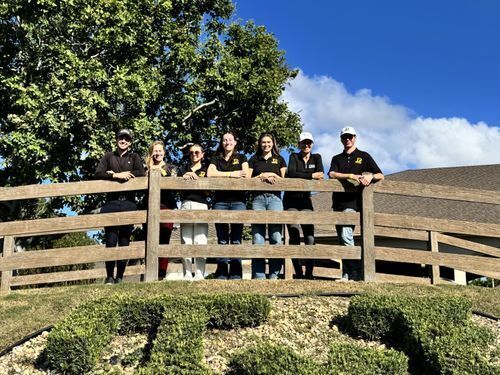
TDF's Dream Program at TYL Farm with Adrienne Lyle and Christian Simonson!
Day Four:
The final day of The Dressage Foundation’s Dream Program: Wellington was a full and inspiring conclusion, highlighted by time spent with several influential industry leaders, including judges Bill Warren and Bill McMullin, Dr. Hilary Clayton, and elite athletes Adrienne Lyle and Christian Simonson.
We began our morning at Global with Dr. Hilary Clayton, a renowned veterinarian, researcher, and author. Dr. Clayton shared an incredible depth of knowledge on equine and rider biomechanics, offering fresh perspectives on improving comfort and suppleness for both. She discussed her extensive research on girths, saddles, bits, and bridles, emphasizing that there is no single “right” option. Instead, she stressed that comfort should always be the priority, and that trial and error is a necessary part of finding what works best for each horse and rider partnership.
Next, we met with Bill McMullin, a USDF Certified Instructor at the FEI B level, USEF “S” judge, and USDF gold medalist, alongside Bill Warren, an FEI 4* and USEF “S” judge and USDF Gold Medalist. Together, they shared valuable insights into the judging process and their personal pathways within the sport. They strongly encouraged participation in the Dressage Development Program, noting its importance in establishing strong fundamentals for both riding and teaching. During our discussion, we watched the CDI 3* Grand Prix while they offered detailed commentary on each test and combination, which was an invaluable learning experience.
Our final visit took us to TYL Farm, where we met Adrienne Lyle and Christian Simonson, two highly accomplished riders on both the national and international stage. We toured the beautiful facility, met their impressive pipeline of horses, and learned about their daily routines and training philosophies. The visit concluded with watching Katie Duerrhammer ride a 10-year-old FEI gelding in a lesson with Adrienne. This session was especially informative, focusing on thoughtful preparation and strategic training. One statement from Adrienne that truly resonated was, “You have to be able to read your horse and be humble enough to change your plan in the moment if something isn’t working.”
Wrap-Up:
Going into The Dressage Foundation’s Wellington Dream Program, I knew I would return home with a wealth of knowledge; however, now that the program has concluded, I have taken away far more than I ever imagined. The week was filled with new perspectives, training philosophies, and meaningful connections.
One of the highlights for me was watching Scott Hassler teach. He made it clear that the primary reason we participate in this sport is for the horse. He emphasized the importance of truly understanding and researching each individual horse and delivering our aids in “horse terms,” allowing them to understand more clearly and perform to their fullest potential.
I also gained several new exercises that I am eager to incorporate into my own training. The use of turn-on-the-forehand was a recurring theme, particularly after observing it at the Dressage Infusion Masterclass. When incorporated thoughtfully, this exercise can enhance a horse’s activity, collection, and submission while still offering a sense of freedom and preventing the horse from feeling restricted. Additionally, counter-canter on a 20-meter circle stood out to me as an effective tool for displacing the inside foreleg, encouraging improved uphill balance and collection.
This program not only provided me with inspiration and the courage to think outside the box, but also the opportunity to connect with individuals I could have only dreamed of meeting. Just as meaningful were the relationships formed with my peers. This year’s group was encouraging, kind, and enthusiastic, qualities the dressage world can never have enough of.
To conclude, I would like to sincerely thank all of the generous donors and The Dressage Foundation for providing the youth of our sport with opportunities of a lifetime. Your continued investment in our education is incredibly meaningful and has a lasting impact that does not go unnoticed. Thank you for your unwavering support.


